 Dbak91
Website Design Consultation: How to Prepare and What to Expect
A website design consultation is a conversation, before any building starts, where you and a web designer or consultant agree what the site must do, who it is for, what it needs and roughly how the project will run. A good one leaves you with a clear plan, a defined scope and a sense of whether you want to work with that person. You can get a lot out of it with about an hour of preparation.
I’m David, the founder of Dbak91. I build custom websites and Android apps for individuals and small businesses in the UK. This guide explains the consultation the way I would explain it to a friend: what to bring, what to ask, and what to do afterwards.
Dbak91Plan a Website That Fits Your NeedsDbak91 builds custom websites for individuals and small businesses, with plain-English support for practical digital projects.VisitTL;DR
- A consultation is for deciding what the site needs to do, not for picking colours. Come with one main goal.
- Bring your audience, examples you like, what you already have, and an honest budget range and timeline.
- Ask about scope, who owns the site, what happens after launch, and how changes are handled.
- Expect a written summary or proposal afterwards. Take your time before you say yes.
- Consultant, designer and developer can be the same person or different people. Ask who does what.
Table of Contents
- What a website design consultation is
- Why the first conversation matters
- How to prepare: seven things to bring
- Questions to ask in the consultation
- What a good consultation covers
- Legal and practical basics to raise
- Red flags and good signs
- Choosing between package types
- Our perspective
- After the consultation
- Booking a consultation with us
- A worked example
- Common mistakes to avoid
- FAQ
- Sources
What a website design consultation is
The word “consultation” covers a few different things. Knowing which one you are booking saves confusion.
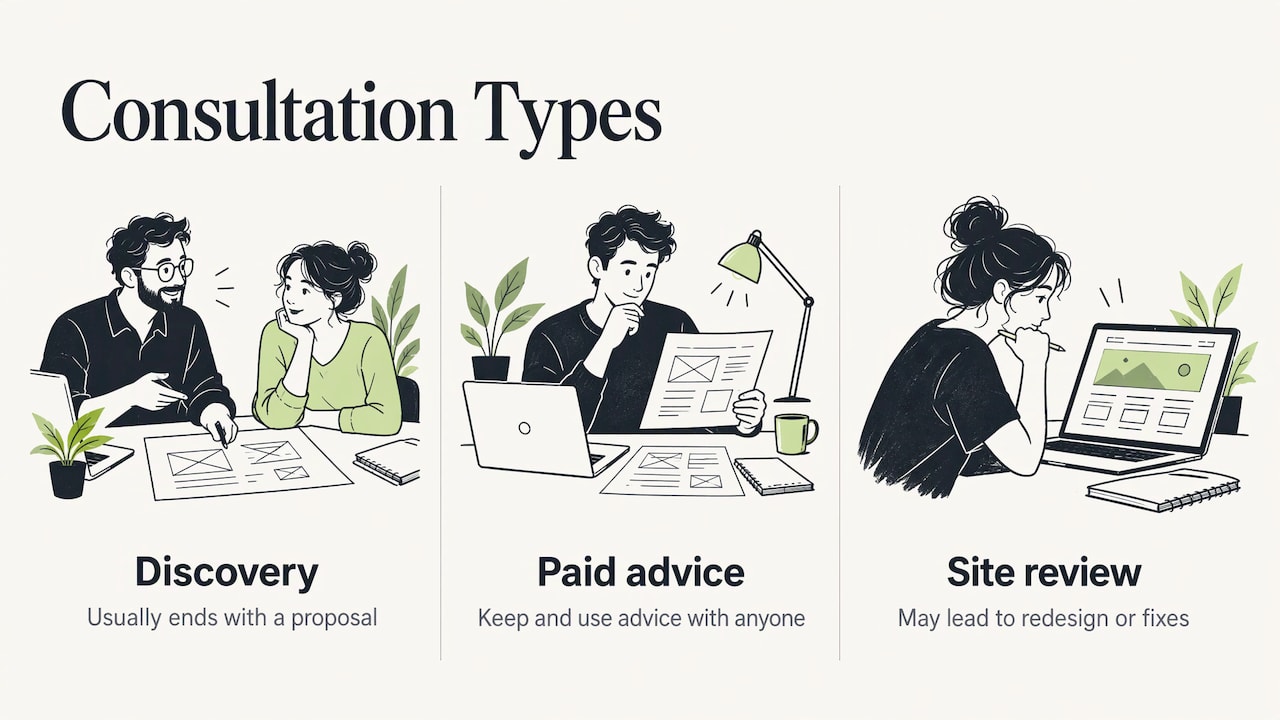
A discovery call before a project. This is the most common kind. You talk with a designer or developer about your idea, and they work out whether they can help and what it would involve. It usually ends with a proposal.
A paid advice session. You pay for someone’s time to look at your plans, your existing site or your options. You keep the advice and can use it with anyone, including doing the work yourself.
A review of a site you already have. Someone looks at what is there and tells you what is working and what is not. This can lead to a redesign, or to a short list of fixes.
People also search for a “web design consultant” or “website design consultant”. In practice, a consultant is someone who advises on what to build and how. A designer focuses on how it looks and feels. A developer builds it. On small projects, one person often does all three. That is how I work, so you talk to the same person from the first conversation to launch.
Why the first conversation matters
Most problems on website projects start with something nobody said at the beginning. The site was meant to bring in enquiries, but nobody planned a clear contact route. The owner expected to edit pages, but the site was built so only a developer can. The budget was one number in the owner’s head and another on the quote.
A consultation is the cheapest place to find these gaps. Changing a plan on paper costs nothing. Changing a built site costs time and money.
It is also your chance to judge the person. You will work with them for weeks or months. Notice whether they ask about your customers, explain things in words you understand, and say what they cannot do as readily as what they can.
How to prepare: seven things to bring
You do not need a finished brief. You need clear answers to a handful of questions. Write them on one page.
1. One main goal
Pick the single most important job for the site. For example:
- Get people to ring or email you for a quote.
- Let customers book a slot.
- Show your work so people trust you.
- Share information for a club, charity or community project.
- Sell a small number of products.
You can add secondary goals, but one main goal helps every decision that follows, from the menu to the wording of a button.
2. Your audience
Describe the people who will use the site. What are they trying to find? What device do they use? How comfortable are they with technology? A site for retired customers booking a repair needs different choices from one for young professionals.
3. Examples you like and dislike
Collect three to five sites you like and say why. “The phone number is easy to find” is more useful than “it looks modern”. Include one you dislike. That tells the designer as much as the ones you like.
4. What you already have
List your domain name, any current site, logo, photos, written text, social media accounts and an email address you use for the business. If you have a site now, note what you want to keep and what frustrates you.
5. Your content
Sites often wait on content, not on design. Think about who will write the text, who will take or supply the photos, and by when. If you are unsure, say so. Many people need help with this and a good consultant will plan for it.
6. A realistic budget range
Give a range, not a secret. A designer can only recommend a sensible approach if they know what you can spend. If you hide the budget, you tend to get a quote that is either far too big or too small for what you need. Costs depend mainly on the number of pages, custom features, content and ongoing support. Our own guide to what custom website development involves and costs walks through those factors.
7. A timeline and any fixed dates
Say if there is a launch event, a busy season or a date tied to a printed leaflet. Also say how much of your own time you can give. Projects slow down when the owner is busy and feedback arrives late.
Questions to ask in the consultation
You are interviewing the consultant as much as they are interviewing you. These questions cover the ground that matters.
About the work
- What exactly will I get? Which pages, which features, how many rounds of changes?
- Who does the design, the building and the writing?
- Will I be able to edit the text and images myself? How?
- How will the site work on a phone?
- How will you make it easy to use for people with disabilities?
About the money
- Is the price fixed for a defined scope, or does it depend on hours?
- What is not included?
- What happens if I want something added halfway through?
- Are there ongoing costs for hosting, a domain name, updates or support?
About ownership and the future
- Who owns the site, the design and the content when it is finished?
- Where is it hosted, and can I move it?
- Who looks after it after launch, and how do I ask for help?
- What happens if either of us wants to stop part-way? Ask to see this in writing. Ours is on our working together and cancellation page.
About working together
- How quickly do you reply, and how do we talk: email, phone, video?
- What do you need from me, and by when?
- When is the site realistically ready?
If an answer is vague, ask again in a different way. A good consultant is happy to be specific.
What a good consultation covers
A useful session usually moves through the same stages. If yours skips one, raise it.
| Stage | What gets decided | What you should hear |
|---|---|---|
| Goals | The main purpose of the site and how you will tell it is working | Questions about your business, not only about design |
| Audience | Who visits and what they need | Real examples of what your customers ask |
| Content and structure | The pages, the menu, who writes what | A simple page list in plain words |
| Features | Forms, booking, shop, maps, anything custom | What is needed now and what can wait |
| Look and feel | Style, branding, examples | Reasons tied to your audience |
| Budget and timeline | Scope, cost, milestones | A clear link between scope and price |
| Next steps | What happens after the call | A written summary or proposal |
Legal and practical basics to raise
A consultant who builds websites in the UK should be comfortable talking about the basics your site will need. You do not need to become a lawyer. You do need to know the topics exist.
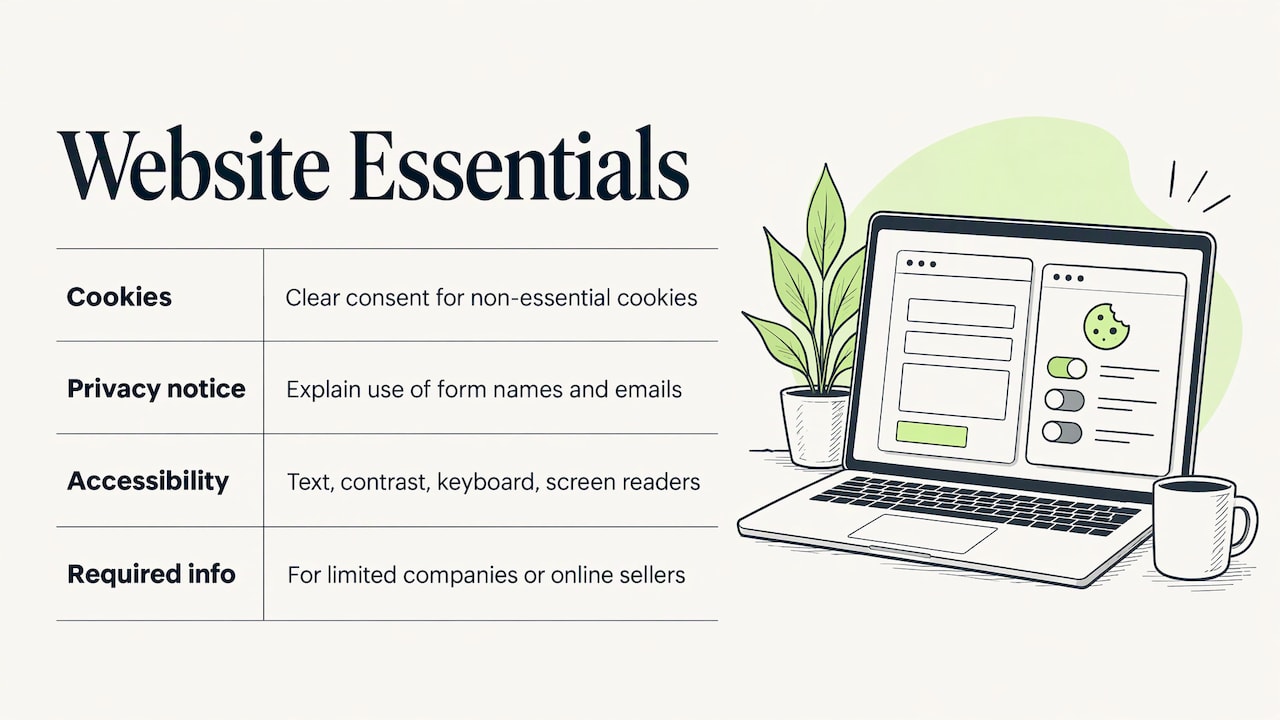
Cookies. If your site sets cookies that are not strictly necessary, such as some analytics or advertising ones, UK rules say you must tell people what they do and get their clear consent first. The Information Commissioner’s Office guidance on cookies sets this out, including the exception for cookies that are essential to provide the service someone asks for. Ask your designer what the site will set and how that will be explained to visitors.
Privacy notice. If your contact form collects names and email addresses, you need to say what you do with them. Ask whether a privacy page is part of the build. You can see what a short, plain notice looks like on our privacy notice.
Accessibility. A website that more people can use is a better website. Ask how text size, colour contrast, keyboard use and screen readers will be handled. We write about this on our accessibility and getting help page.
If your business is a limited company, or you sell online, you will also have some information you must show on the site. Ask your adviser, accountant or the relevant government guidance to confirm exactly what applies to you.
Red flags and good signs
You will pick up a lot from the tone of the call.
Good signs
- They ask about your customers and your goals before talking about design.
- They explain terms in plain English without making you feel silly.
- The scope is written down, with what is and is not included.
- They tell you honestly when something is not worth building yet.
- They are clear about their availability.
Warning signs
- A price with no explanation of what it covers.
- Pressure to decide on the call.
- Jargon used to avoid answering a question.
- No mention of who owns the site afterwards.
- No plan for support once the site is live.
Choosing between package types
Most small projects fit one of three shapes. Here is how we think about them at Dbak91.
- Starter Website. For an individual, a club or a very small business that needs a clear, simple online presence.
- Business Website. For a business that needs more pages, more content and a stronger structure to bring in enquiries.
- Premium Website. For projects that need more tailored design or features.
We do not publish prices for these, because the right figure depends on your scope. That is exactly what a consultation is for. You describe the project, and we give you a clear, scoped proposal. You can read more on our website and Android app services page.
Our perspective
Most people who contact me are not web experts, and they should not need to be. They have a business, a club or an idea, and they want a website that does a job. My aim in a first conversation is to turn that into a short, clear plan in plain English.
I work on private projects at weekends, alongside my full-time job. I tell people this at the start. It means I take on projects I can give proper attention to, and I agree timelines that I can keep. I would rather be honest about my availability than promise something I cannot deliver.
I also build things that solve real problems. My brother is non-verbal and autistic, and that led me to build a free, open-source communication soundboard. That work taught me to ask what a person actually needs, and to design around real use rather than assumptions. I bring the same approach to a business website: who is using it, on what device, trying to do what?
Clear scope, affordable work and straight answers matter most to small businesses and individuals. That is what I aim to offer, and it is why I think a short conversation up front is the best way to start.
David
After the consultation
The call is the start, not the end. Here is a sensible order for what follows.
- Ask for a written summary. It should list the goals, the pages and features, what is excluded, the price or how it is calculated, the timeline and who owns what.
- Read it away from the call. Check it against your one-page notes. Does it match what you said you needed?
- Ask questions. Anything unclear is worth raising before you sign or pay.
- Compare like with like. If you speak to more than one person, compare scope as well as price. Two quotes can look different simply because they include different things.
- Check the terms. Look at cancellation, changes and support.
- Decide, then prepare your content. Once you say yes, the quickest way to a good launch is to get your text and images ready early.
Booking a consultation with us
If you are planning a website or a custom Android app, or you want technology and software advice before you commit, we would be glad to hear from you. Tell us what you want to achieve, who the site is for and roughly what you can spend, and we will help you work out the right size of project. We keep the language plain and the scope clear.
See the Starter, Business and Premium website options and our other services, or start from the Dbak91 home page. If you would like to see more of what we write about, our blog has more guides.
A worked example
Here is a made-up but typical scenario, to show how preparation changes a call.
Sam runs a small dog-walking business. Before the consultation, Sam writes one page:
- Goal: get more local owners to request a walk.
- Audience: busy people in a few nearby streets, mostly on their phones.
- Examples: one site with a big phone number at the top, which Sam likes; one with lots of pop-ups, which Sam does not.
- Have already: a logo, thirty photos, a social media page.
- Content: Sam will write the text, and wants help with the structure.
- Budget and timeline: a range Sam is comfortable with, and a hope to launch before spring.
With that page, the consultation can go straight to decisions. A short site with a home page, services, prices, about and contact. A simple enquiry form. A clear phone number. A privacy page. No pop-ups. The consultant can then write a proposal that is easy to compare and easy to say yes or no to.
Without the page, the same hour could be spent on what Sam “thinks” a website should have, and the proposal would be a guess.
Common mistakes to avoid
- Trying to cover everything. A site with many goals often serves none well. Start with one and add later.
- Choosing on looks alone. A beautiful page that does not make it easy to contact you is not doing its job.
- Keeping the budget secret. It makes advice worse, not cheaper.
- Leaving content until last. Waiting for text and photos is the most common cause of delay.
- Skipping the ownership question. Know who holds the domain, the hosting account and the files.
- Ignoring life after launch. Sites need updates, backups and someone to call when something breaks.
FAQ
How long does a website design consultation take?
Most take between thirty minutes and an hour. Preparation makes a shorter call more productive. If your project is complex, ask whether a second session would help before a proposal is written.
Is a website design consultation free?
It depends on the provider. Some offer a short introductory chat before a project, and others charge for advice sessions. Ask when you book, so you know what is included. Our technology and software advice is a paid service, and you can ask us about the details on our services page.
Do I need a website designer or a consultant?
If you already know what you want built, a designer or developer is enough. If you are unsure about goals, features or budget, start with someone who will advise first. On smaller projects one person often does both, which keeps things simple.
What should I have ready before the call?
Bring one main goal, a description of your audience, a few example sites, a list of what you already have, a budget range and a timeline. One page of notes is plenty. The more specific you are, the more specific the advice you get.
What should I get afterwards?
You should receive a clear written summary or proposal. It should say what is included, what is not, the cost, the timeline, who owns the finished site and how support works. If something is missing, ask for it before you agree.